

Wireless HART Instrumentation
Wireless security is critical to the successful deployment of both field instrument
networks and plant application solutions.
WirelessHART is a wireless mesh network communications protocol for process automation applications.
It adds wireless capabilities to the HART protocol while maintaining compatibility with existing HART devices, commands and tools.
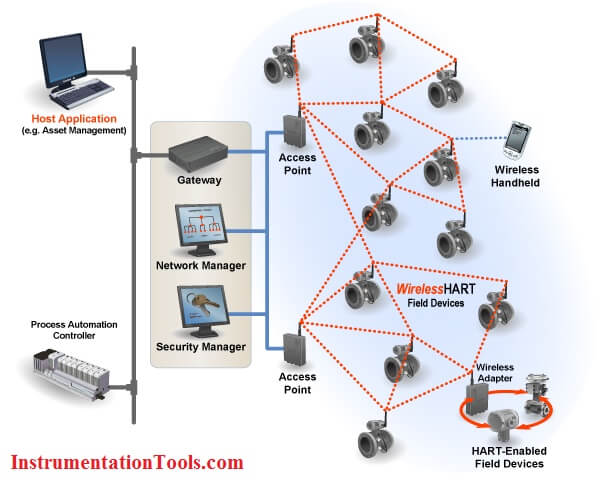
Each WirelessHART network includes three main elements:
- Wireless field devices connected to process or plant equipment
- Gateways that enable communication between these devices and host applications connected to a high-speed backbone or other existing plant communications network
- A network manager responsible for:
– Configuring the network
– Scheduling communications between devices
– Managing message routes
– Monitoring network health
Each of the wireless network devices, PDAs, laptops, RFID tags, or field instrument wireless Gateways, has its traffic routed from the device to one of the plant network mesh access points. From there the communication travels back through the mesh network until it reaches the root access point. The communication passes directly to the managed switch where the virtual LANs are split in the different physical LANs. The communication is finally routed through a firewall at each network level that serves as “belt and suspenders” to ensure only traffic meant for each network level is routed through. Finally, the communication is routed to the appropriate final network device.
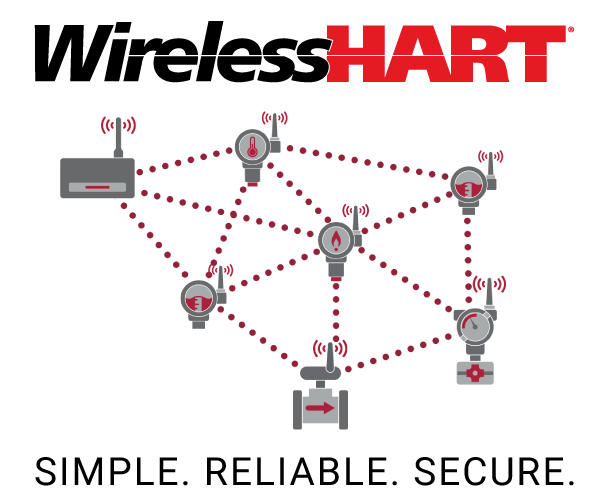
It extends wired HART technology by using 2.4 GHz radio, connecting field instruments to a central gateway for diagnostics and monitoring. It provides high reliability through self-healing, self-organizing networks; making it ideal for monitoring without expensive wiring.
Key aspects of WirelessHART
- Technology: Operates on IEEE 802.15.4, utilizing mesh networking where devices act as routers, allowing data to bypass obstructions.
- Reliability & Security: Features channel hopping to avoid interference, alongside 128-bit AES encryption and secure device authentication.
- Benefits: Reduces installation costs, allows for easier production expansion, and enables predictive maintenance by transmitting diagnostics.
- Flexibility: Battery-powered, with devices typically lasting 3–8 years.
- Integration: Easily integrates with existing SCADA or DCS systems.